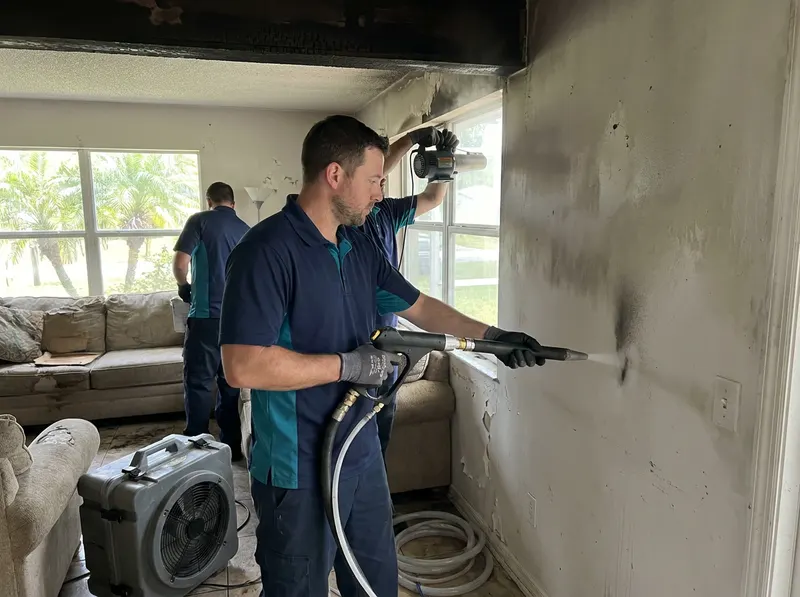
A fire leaves three separate problems that a restoration crew treats in order: the water dumped by fire hoses, the soot and char coating surfaces, and the smoke odor bonded into porous materials. Orlando's humidity, averaging over 70% for much of the year, means firefighting water left in drywall and subfloor grows mold within 24, 48 hours, so extraction and drying come first even on a job people think of as "just smoke." Soot is acidic; it etches metal, glass, and grout within days, which is why appliances and window frames near a Baldwin Park or College Park kitchen fire are wiped and pH-neutralized early rather than left to corrode.
Smoke odor is the hardest part to remove because smoke particles are microscopic and lodge inside drywall, insulation, carpet padding, and HVAC ductwork. Surface wiping alone does not clear it. Restoration uses thermal fogging (a heated deodorizer that mimics smoke's path into pores) or ozone/hydroxyl treatment in sealed rooms, plus HEPA air scrubbers running for days. Homes with central air near Lake Nona and Hunter's Creek often need the entire duct system cleaned, because the blower pulls soot through the house and re-deposits a gray film on ceilings and vents long after the fire is out.
Deciding what to clean versus replace drives the cost. If soot damage is light and confined to one room, a stovetop grease fire in a Winter Park bungalow, for example, cleaning and deodorizing without demolition is the fit, and the job stays in the low thousands. If framing is charred or drywall is saturated with both soot and hose water, that section is cut out and rebuilt, which moves the job into demolition, disposal, and reconstruction. As a rule: if the material is only coated, it is cleaned; if it is charred through or structurally weakened, it is removed. A restoration company also documents smoke and water damage room by room for the homeowner's insurance claim, since fire losses in Florida are almost always filed against a homeowner policy.
The typical sequence is straightforward: (1) emergency board-up and roof tarping to secure the structure; (2) water extraction and setup of drying equipment; (3) soot removal and pH cleaning of salvageable surfaces; (4) demolition of unsalvageable framing and drywall; (5) deodorizing and HEPA air scrubbing; (6) reconstruction and finishing. Content items, furniture, clothing, electronics, are inventoried and either cleaned on-site or moved out for off-site restoration.