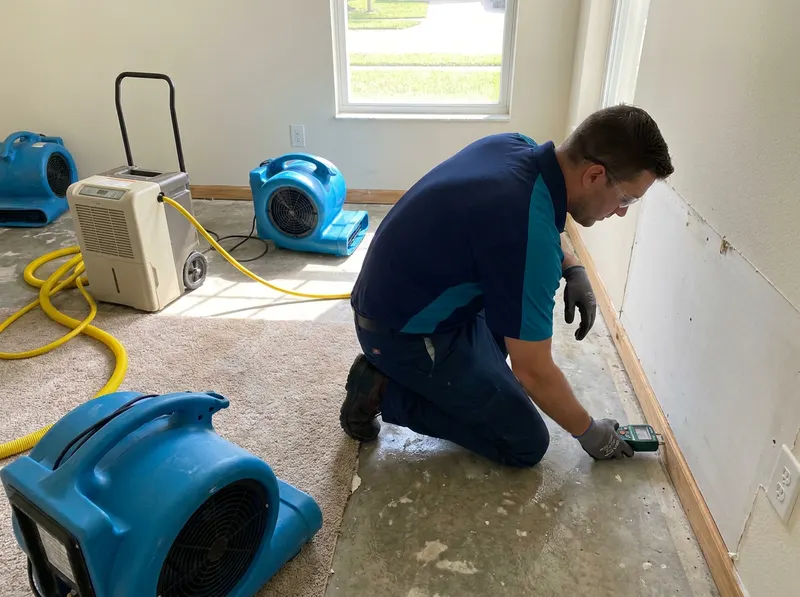
Structural drying follows a set sequence. First, standing water is extracted. Second, wet materials are mapped with a moisture meter and a dry standard is set from an unaffected area of the same material, a dry interior wall in the Milk District bungalow, or a dry slab section in a College Park block home. Third, air movers are positioned at 12-to-16-inch intervals along wet walls to lift moisture off surfaces, and LGR dehumidifiers pull that moisture out of the air. Fourth, readings are logged daily until the wet materials match the dry standard. The equipment stays on 24 hours a day; switching it off overnight restarts the clock.
Orlando's climate is the reason dehumidification is not optional here. Summer dew points in Orange County regularly exceed 75°F, so a home left with open windows and a box fan traps humidity rather than releasing it. LGR dehumidifiers can pull moisture down to lower grain levels than standard refrigerant units, which matters in July and August when ambient air is already saturated. Concrete slab foundations, common across Pine Hills, Conway, and much of the 32812 and 32808 zones, hold water differently than wood, releasing it slowly through the surface, which is why slab dry-outs run longer.
Drying is the right service when water has been extracted but materials are still wet and structurally sound. If drywall has swelled, delaminated, or wicked water more than 24 inches up the wall, controlled demolition of that section is usually faster and cheaper than trying to dry it in place. A single-room kitchen leak near Winter Park may dry with two air movers and one dehumidifier; a whole-floor loss from a burst supply line in a two-story Lake Nona house needs a larger equipment package and longer monitoring. The trade-off is time versus tear-out: drying saves finishes but takes days, while demolition is immediate but rebuilds cost more.
Daily monitoring is what separates real structural drying from renting fans. Meter readings, temperature, and relative humidity are recorded each visit and compared against the dry goal, which follows the moisture-mapping practice described in the IICRC S500 water-damage standard. When every wet material meets its dry standard, equipment is removed and the space is cleared for repairs. Hidden moisture in wall cavities and under cabinets is the most common reason a room 'looks dry' but still grows mold weeks later.